



Standard vs Custom Mechanical Seals: Differences and Selection Guide
Choosing the right mechanical seal can make a significant difference in equipment performance, maintenance costs, and production uptime. A seal that fits poorly or does not suit the operating conditions may lead to leakage, repeated repairs, and unexpected shutdowns.
For industrial businesses in Chhapi, Gujarat, and across India, the decision often comes down to two options: a standard mechanical seal or a custom-designed solution. Both have their place, but the right choice depends on your equipment, operating environment, fluid properties, and long-term maintenance requirements.
At LEAK-PACK, we understand that selecting a sealing component involves more than matching dimensions. It requires a clear understanding of how the equipment operates and what the application demands.
In this guide, we explain the key differences between standard and custom mechanical seals, their advantages, and how to choose the right option for your industrial application.
What Is a Mechanical Seal, in Plain Words?
A mechanical seal stops liquid from escaping along a rotating shaft, usually in a pump or mixer. Two flat faces, one rotating and one fixed, press lightly against each other with a thin liquid film between them. That film is what keeps the seal cool and leak-free.
Most seals are built from a few parts:
- Seal faces (carbon, silicon carbide, tungsten carbide, ceramic)
- Elastomers (Viton, EPDM, Nitrile, PTFE and others)
- Springs that keep face pressure steady
- Metal parts such as the sleeve and gland (SS304, SS316 or special alloys)
Change any one of these and the seal behaves differently in the field. That is why one seal can last two years in one plant and two weeks in another.
What Are Standard Mechanical Seals?
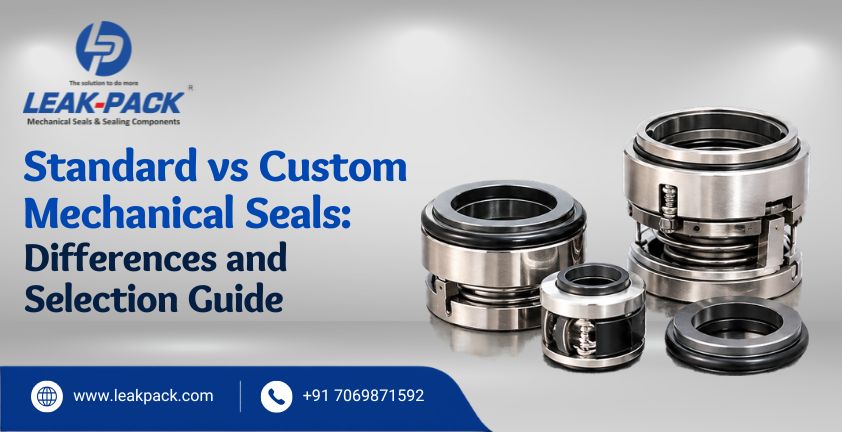
Standard seals follow common dimensions and designs, so they fit widely used pumps without special machining. Think of single-spring or multi-spring seals, rubber bellow types, and cartridge seals in common sizes.
Where standard seals work well
- Water, light oils and mild chemicals at moderate temperature
- Common centrifugal pumps and circulation pumps
- Plants that want quick replacement and low stock complexity
- Budget-sensitive jobs where downtime is not critical
Where they fall short
Standard seals are designed for the “average” duty. If your liquid is abrasive, sticky, crystallising or very hot, an average design starts to struggle. You then see short seal life, frequent dry running damage, or leakage after every restart.
What Are Custom Mechanical Seals?
A custom seal is engineered around your specific equipment and process. The design, face materials, elastomers and metallurgy are chosen from your actual operating conditions rather than from a catalogue size.
Custom does not always mean expensive or exotic. Sometimes it is a small change, such as a different face pair or a longer sleeve, that finally solves a recurring problem.
Common reasons plants go custom
- Old or imported pumps with non-standard shaft or housing dimensions
- Slurries, acids, solvents, hot oils or viscous products
- High pressure, high speed or wide temperature swings
- The same seal failing again and again, no matter who supplies it
- Process rules around contamination, such as food, pharma or fine chemicals
Standard vs Custom Mechanical Seals: Side-by-Side
| Factor | Standard Seal | Custom Seal |
|---|---|---|
| Fit | Common pump sizes and shaft dimensions | Made to your exact shaft, housing and space |
| Lead time | Usually short, often from stock | Longer, as design and manufacturing are involved |
| Upfront cost | Lower | Higher |
| Media handling | Clean or mildly aggressive liquids | Abrasive, corrosive, hot or viscous media |
| Service life in tough duty | Often short | Usually much better when designed correctly |
| Best for | Routine, low-risk applications | Critical pumps and recurring failures |
💡 Pro Tip: Do not compare seal prices alone. Compare the cost per month of running. A seal that costs 30% more but lasts three times longer saves money, labour and a lot of 2 a.m. phone calls.
A Real-World Scenario: Chemical Transfer Pump
Imagine a small chemical unit in Gujarat transferring a mildly acidic liquid with some solids. The team installs a standard seal with ceramic faces and Nitrile rubber. It leaks within three weeks.
The fix was not a bigger seal. It was a better material match, silicon carbide faces and a chemically compatible elastomer, along with a flush arrangement to keep solids away from the faces. Same pump, same liquid, very different result.
This is the kind of problem a good manufacturer should help you diagnose before quoting anything.
How to Select the Right Mechanical Seal: A Practical Checklist
Before you talk to any supplier, gather these details. They make your quote faster and far more accurate.
- Pump make, model and shaft size. A photo of the nameplate helps.
- Liquid being pumped. Name, concentration, solids content, viscosity.
- Temperature range. Include start-up and cleaning temperatures, not just normal running.
- Pressure and speed (RPM).
- Operating pattern. Continuous, batch, or frequent start-stop.
- Failure history. How long the last seal lasted and how it failed.
Match the materials carefully
- Carbon vs silicon carbide: Carbon is gentle and economical for clean liquids. Silicon carbide handles heat and abrasion better.
- Elastomer choice: Viton suits many oils and chemicals, EPDM suits hot water and some alkalis, and PTFE suits harsh chemicals.
- Metal parts: SS316 is a safer pick than SS304 where chlorides or mild acids are present.
💡 Pro Tip: Dry running is the silent killer of seals. If your pump may run without liquid even briefly, tell your supplier. It can change the face pairing and the recommended design.
Choosing a Mechanical Seals Manufacturer You Can Rely On
When buyers search for mechanical seals manufacturers, they usually find long lists of names. The harder part is knowing who will actually stand behind the product after delivery. Whether you are comparing mechanical seals manufacturers in India or looking closer to home among mechanical seal manufacturers in Gujarat, a few questions help separate the serious ones:
- Do they ask about your process, or just your shaft size?
- Can they offer both standard and custom options, so you are not pushed into one?
- Do they share material test details and give clear drawings?
- Is replacement support reachable, ideally in your region?
- Will they review a failed seal with you, rather than just sell another?
For plants around Chhapi and the wider North Gujarat belt, a supplier within driving distance matters more than people expect. Faster site visits, quicker emergency supply and simpler communication all add up. If you are shortlisting mechanical seal suppliers in India, ask each one how they handle urgent breakdown orders. The answer tells you a lot.
Should You Go Standard or Custom? A Quick Decision Guide
Choose standard if:
- The pump is common and the liquid is clean or mild
- Past seals have lasted a reasonable time
- You need fast replacement at low cost
Choose custom if:
- The same seal keeps failing early
- The pump is old, imported or has unusual dimensions
- The process is hot, abrasive, corrosive or tightly regulated
- Downtime on that pump is expensive
Still unsure? Start with a failure review. Many plants find that a modest custom tweak on one critical pump pays back quickly, while the rest of the pumps happily run on standard seals.
Frequently Asked Questions
1. What is the main difference between standard and custom mechanical seals?
Standard mechanical seals use established designs and dimensions, making them suitable for many conventional applications. Custom mechanical seals are designed or modified to meet specific equipment dimensions, fluid properties, or operating conditions.
2. Are custom mechanical seals more expensive than standard seals?
Custom seals may cost more initially because they can require engineering, specialised materials, and additional manufacturing work. However, the right design may reduce replacement frequency and maintenance costs in applications where standard seals are unsuitable.
3. How do I choose the right mechanical seal for my pump?
Check the shaft dimensions, seal chamber, fluid type, operating pressure, temperature, and rotational speed. If you are unsure, provide the equipment details or existing seal sample to a qualified manufacturer for assessment.
4. Can mechanical seals be manufactured from an existing sample?
Yes, a manufacturer may be able to inspect and reproduce or improve a seal using an existing sample. The feasibility depends on the sample’s condition, the available measurements, and the equipment requirements.
5. How do I find reliable mechanical seals manufacturers in India?
Look for manufacturers with relevant product experience, material-selection expertise, quality-control processes, and technical support. Ask whether they can evaluate your equipment specifications and provide suitable standard or custom solutions.
6. Which industries commonly use custom mechanical seals?
Custom mechanical seals are used in chemical processing, pharmaceuticals, petrochemicals, oil and gas, food processing, power generation, and other industries. They are especially useful when equipment has specialised dimensions or demanding process conditions.
7. What information is needed to order a custom mechanical seal?
Ideally, provide the equipment model, shaft dimensions, process fluid, operating pressure, temperature, speed, and existing seal drawing or sample. If some information is unavailable, the manufacturer can help identify the measurements and details required.
8. Are mechanical seal manufacturers in Gujarat suitable for specialised industrial applications?
Manufacturers in Gujarat serve a range of industrial applications, including chemical processing and rotating equipment. When choosing a supplier, confirm that its engineering capabilities, product range, and quality processes match your requirements.
9. Can a standard mechanical seal be modified instead of manufacturing a completely custom seal?
In some cases, an existing design can be adapted to suit the equipment or process. A manufacturer should first evaluate whether the modification is technically suitable and maintains the required performance and operating limits.
10. Where can I find mechanical seal suppliers in India for non-standard equipment?
Start with manufacturers that accept equipment drawings, existing samples, and application-specific enquiries. LEAK-PACK in Chhapi, Gujarat, offers mechanical seals and custom sealing solutions for pumps, mixers, reactors, and other rotating equipment.

 download catalogue