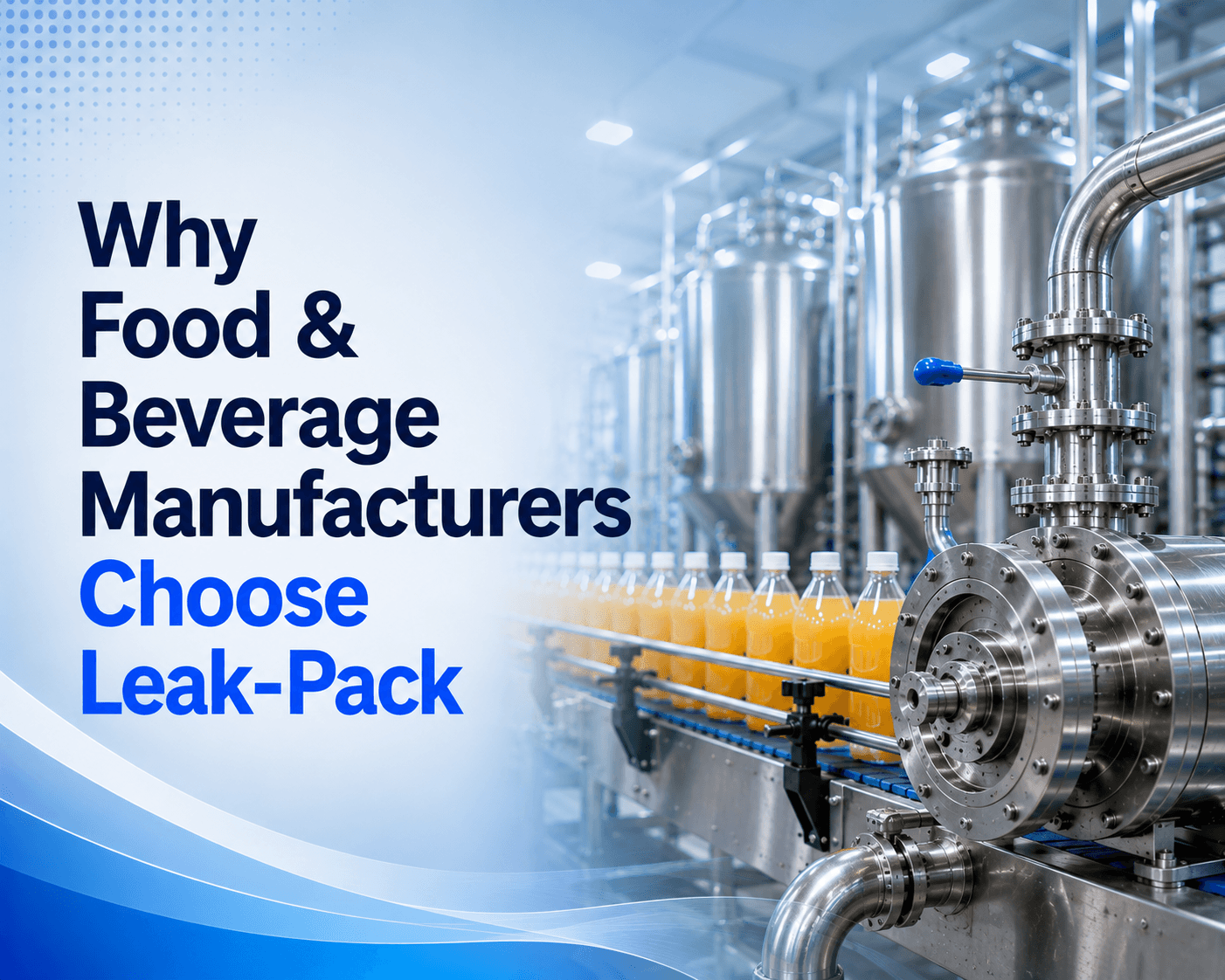
Food & Beverage Industry

Mechanical Seals for the Food & Beverage Industry

Food and beverage processing runs on the same core requirement as pharmaceutical manufacturing — every wetted surface a product touches has to be contamination-free and fully cleanable — but at production volumes and duty cycles that are usually far higher. Mixers, blenders, homogenizers, and transfer pumps on a food or beverage line run near-continuously between cleaning cycles, and the mechanical seal on that equipment is one of the few rotating components in direct contact with the product. A seal that isn’t built for hygienic service is a contamination risk and a line-stoppage risk in the same part.

At Leak-Pack Engineering, we design and manufacture mechanical seals for food and beverage process equipment, built around the hygienic design principles maintained by 3-A Sanitary Standards, Inc. — crevice-free construction, cleanable surface finishes, and materials that hold up to repeated clean-in-place (CIP) and steam-in-place (SIP) cycles. Whether you’re sealing a dairy pasteurizer, a beverage filling line, or a fruit pulp transfer pump, our engineering team works from your product contact requirements and cleaning regime to recommend the right seal design and materials.

Why Hygienic Design and Cleaning Cycle Life Matter

Why Hygienic Design and Cleaning Cycle Life Matter

In food and beverage processing, a seal doesn’t just have to seal — it has to survive its cleaning regime as many times as the process demands, without degrading in a way that creates a contamination risk. A dairy line might run a full CIP cycle daily; a beverage filler might run several sanitation cycles per shift. Standard elastomers and O-ring designs that would last years in general industrial service can harden, crack, or lose sealing force after a few hundred steam or caustic CIP cycles — well within a single production year on a high-throughput line.

This is also where regulatory and customer audit exposure enters seal selection. Facilities supplying branded food and beverage manufacturers are routinely audited against hygienic equipment design expectations — whether formally through FDA food facility regulations or through a customer’s own supplier quality program — and equipment with crevices, dead legs, or non-food-grade wetted materials is one of the most common findings in these audits. We design seals to pass that scrutiny from the outset, not retrofit compliance onto a standard industrial seal afterward.

Getting cleaning-cycle life wrong is expensive in a specific way: a seal that starts leaking slightly after repeated CIP cycling often gets diagnosed as a maintenance issue and simply replaced, again and again, without anyone flagging that the underlying elastomer or arrangement was never rated for the actual cycle frequency the line runs. We size seal materials to your real cleaning schedule, not a generic “food grade” default.
Equipment We Seal Across Food & Beverage Processing

Equipment We Seal Across Food & Beverage Processing

Food and beverage facilities run a wide mix of mixing, processing, and filling equipment, each with its own hygienic and duty-cycle demands. We supply seals across this full range:

  • Mixers, Blenders & Homogenizers: Product mixing and blending vessels need seals that clean out completely under CIP without disassembly, with no crevices where product residue can be trapped between batches — our Agitator, Mixer & Reactor Seals are built for this duty.
  • Dairy Processing & Pasteurization Lines: Pasteurizers and dairy transfer pumps run frequent steam sanitation cycles, which quickly degrade standard elastomers. We typically specify Metal Bellow Mechanical Seals or steam-grade elastomer cartridge seals depending on cycle frequency and temperature.
  • Beverage Filling & Carbonation Systems: Filling lines demand consistent, repeatable seal performance across high-speed, high-uptime operation. Our Cartridge Mechanical Seals are pre-assembled and pre-set, reducing installation variability across a filling line’s full pump count.
  • Fruit Pulp, Puree & Particulate Transfer: Media containing fruit solids, pulp, or fiber will clog a standard single-spring seal quickly — our Multi Spring Mechanical Seals distribute closing force across multiple springs to resist this.
    • Clean-in-place (CIP) and steam-in-place (SIP) systems — seals rated for repeated thermal and chemical sanitation cycles
    • Centrifuges and separators — hygienic seals for solid-liquid separation in juice, dairy, and oil processing
    • Large sterile or high-throughput vessels — Split Mechanical Seals for replacement without full shaft removal
Sealing Challenges Specific to Food & Beverage Processing

Sealing Challenges Specific to Food & Beverage Processing

Hygienic Design Requirements

  • Crevice-free construction so the seal can be fully cleaned in place without trapping product or cleaning residue
  • Surface finish requirements on wetted components, consistent with 3-A hygienic design principles
  • Materials that withstand repeated CIP and SIP cycles without degrading or shedding particulates into the product

Cleaning Cycle Frequency & Cycle Life

  • Daily or multiple-times-per-shift steam and caustic sanitation cycles
  • Elastomer and seal face degradation accelerating well ahead of a seal’s nominal service life under high cycle frequency
  • Thermal shock from rapid transitions between production temperature and sanitation temperature

Product & Regulatory Compliance

  • Food-grade material certification for all product-contact components
  • Compliance expectations tied to FDA food safety regulations and customer supplier-quality audits
  • Traceability documentation for wetted materials during facility audits

As with pharmaceutical processing, these requirements interact rather than standing alone — a dairy pasteurizer seal typically has to satisfy hygienic design, cleaning cycle life, and food-grade material compliance simultaneously. We treat that as a single specification exercise rather than three separate checklists.

Seal Types We Supply for Food & Beverage Service

Seal Types We Supply for Food & Beverage Service

  • Hygienic Cartridge Seals: Pre-assembled, crevice-free designs built for tool-free cleaning access and consistent, repeatable installation across a plant’s full mixer and pump fleet.
  • Metal Bellow Seals: For dairy and process lines running frequent high-temperature SIP cycles, removing the dynamic elastomer that would otherwise degrade under repeated thermal cycling.
  • Agitator & Mixer Seals: Purpose-built for the shaft loading patterns of food and beverage mixing vessels, maintaining a validated seal through repeated CIP cycles.
  • Multi Spring Mechanical Seals: Resist clogging in fruit pulp, puree, and other particulate-bearing media where a single-spring design would foul quickly.
  • Split Mechanical Seals: For large processing vessels where full shaft removal for seal replacement would mean extended production loss on a high-throughput line.
  • Rubber Bellow Mechanical Seals: A cost-effective option for less demanding hygienic duty where full metal bellow construction isn’t required.
  • Seal Support Systems: Barrier fluid systems for double-seal arrangements on sterile or high-purity product lines where any product contact with atmosphere is unacceptable.
Common Causes of Seal Failure in Food & Beverage Plants — and How We Design Around Them

Common Causes of Seal Failure in Food & Beverage Plants — and How We Design Around Them

  • Elastomer hardening from repeated steam/caustic CIP exposure — addressed by specifying steam-grade elastomers or elastomer-free metal bellow designs where cycle frequency demands it
  • Seal face clogging in pulp, puree, or fiber-bearing media — addressed with multi-spring designs that resist fouling between springs
  • Crevices and dead legs — geometry that traps product or cleaning fluid, leading to failed CIP validation and audit findings; we design wetted surfaces for complete cleanability
  • Thermal shock at cleaning cycle transitions — addressed through face material and clearance design suited to rapid temperature swings
  • Dry running during product changeovers — loss of lubricating film during line transitions, addressed through support system and flush plan design
Our Engineering & Support Process

Our Engineering & Support Process

  • Product contact and cleaning regime review — CIP/SIP frequency, temperature, and chemical concentration
  • Seal arrangement recommendation — single or double, based on product sterility and contamination risk
  • Material selection for hygienic design and cleaning cycle life
  • Drawing approval before manufacturing begins — including fully custom-engineered designs for non-standard vessels and imported equipment
  • In-house manufacturing and quality testing with material traceability documentation
  • Installation guidance and, where required, on-site commissioning support
Why Food & Beverage Manufacturers Choose Leak-Pack

Why Food & Beverage Manufacturers Choose Leak-Pack

  • Hygienic, crevice-free seal designs built around 3-A hygienic design principles
  • Materials selected for your actual cleaning cycle frequency, not a generic “food grade” default
  • Multi-spring designs for pulp, puree, and other particulate-bearing product lines
  • Food-grade material traceability documentation for supplier and regulatory audits
  • Fast turnaround for replacement seals to minimize high-throughput line downtime
  • Direct engineering support — not just a catalogue sale

Material Selection Guide

Below is a general guide to the materials we typically recommend by food and beverage application. Final material selection is always confirmed against your specific product, cleaning regime, and any regulatory or customer audit requirements that apply to your facility.

ApplicationSeal Face CombinationSecondary Seal / ElastomerWetted Metallurgy
General hygienic mixing/transferSilicon Carbide vs. Silicon CarbideEPDM (steam-grade)316L Stainless Steel
Dairy processing & CIP/SIP linesSilicon Carbide vs. Silicon CarbideFFKM (Kalrez-type)316L Stainless Steel
Carbonated beverage fillingSilicon Carbide vs. Silicon CarbideEPDM (steam-grade)316L Stainless Steel
Fruit pulp / particulate mediaTungsten Carbide vs. Silicon CarbideEPDM / FKM316L SS / Duplex
High-temp UHT & retort serviceSilicon Carbide vs. Silicon CarbidePTFE / Metal bellow (no elastomer)316L Stainless Steel

Frequently Asked Questions

Yes. We size seal materials — including steam-grade elastomers or elastomer-free metal bellow designs — to your actual cleaning cycle frequency, not a generic food-grade default, so the seal is rated for the cycle life your line actually runs.

We design our food and beverage seals around the hygienic design principles maintained by 3-A Sanitary Standards, Inc. — crevice-free construction, cleanable surface finishes, and food-grade materials on all product-contact components.

Yes. Our multi-spring seal designs distribute closing force across multiple springs, resisting the clogging that a single-spring design experiences in pulp, puree, or fiber-bearing media.

Yes. We can supply material certification and traceability documentation for wetted components where your facility’s regulatory submissions or customer supplier-quality programs require it.

Yes. For applications where any product contact with atmosphere is unacceptable, we engineer double seal arrangements with a validated, product-compatible barrier fluid through our seal support systems.

Yes. Our cartridge and agitator seal designs are engineered for retrofit onto most existing food and beverage equipment, including as a direct replacement for seals that are failing prematurely under your cleaning regime.

We supply seals for dairy pasteurizers and processing lines specifically, including metal bellow designs suited to the frequent high-temperature steam sanitation cycles typical of dairy operations, in addition to general food and beverage equipment.

Lead times depend on seal size, arrangement, and any custom documentation requirements. For standard cartridge seal replacements, we prioritize fast turnaround to minimize production line downtime — share your seal drawing or equipment details with our team for a firm timeline.

Talk to Our Sealing Engineers

Every food and beverage line runs a different combination of product, cleaning regime, and throughput demand, which is why we don’t work off a fixed catalogue selection for this industry — every seal we quote starts with your actual process and cleaning cycle requirements. We’re happy to work alongside your quality and food safety teams where a seal specification needs to be reviewed as part of a broader supplier audit or hygienic design documentation package.

Send us your mixer, pump, or filling line specifications — product contact requirements, cleaning cycle frequency, and operating conditions — and our engineering team will recommend the right seal solution for your application. Explore our full range of mechanical seals by industry or send an enquiry directly.