



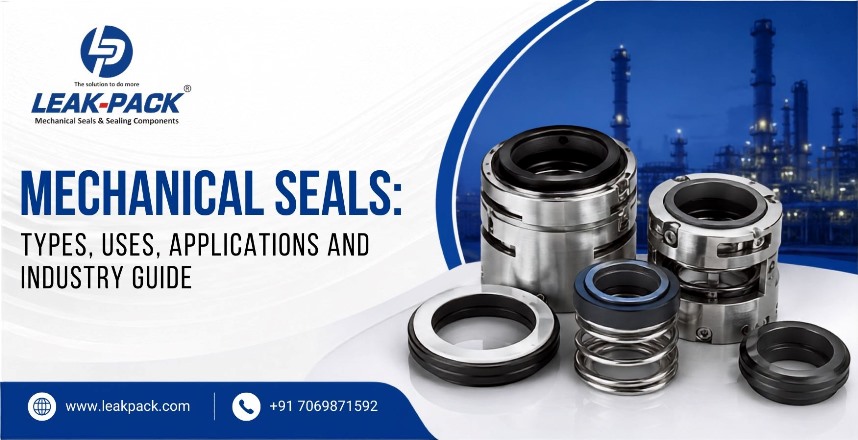
Mechanical Seals: Types, Uses, Applications and Industry Guide
If a pump, mixer, or reactor in your plant is leaking, running hot, or failing early, the mechanical seal is usually the first place to look. It’s a small component, but it does one of the hardest jobs on any piece of rotating equipment: keeping process fluid inside a vessel while a shaft spins through it thousands of times a minute.
This guide breaks down what a mechanical seal is, the major seal types available today, where each one is used, and how to choose the right seal for your application – whether you’re specifying seals for a new pump skid or replacing a seal that keeps failing. If you already know what you’re looking for, you can jump straight to Leak-Pack’s full mechanical seals range.
What Is a Mechanical Seal and How Does It Work?
A mechanical seal is a precision device that prevents leakage of liquid or gas from the point where a rotating shaft passes through a stationary housing – typically a pump, mixer, agitator, or reactor. It works by holding two flat faces (one rotating with the shaft, one stationary in the housing) tightly against each other, with a spring providing the closing force and a thin fluid film between the faces preventing dry contact.
Unlike traditional compression packing, which relies on friction and constant tightening to control leakage, a mechanical seal is designed to run with near-zero visible leakage while the faces themselves wear only microscopically over years of service. The Fluid Sealing Association notes that properly selected mechanical seals can operate for years without adjustment when matched correctly to the application, which is why they’ve become the standard sealing method for process pumps across most industries.
Why Mechanical Seals Matter in Rotating Equipment
Seal failure is one of the leading causes of unplanned pump downtime in process plants. A failed seal doesn’t just mean a maintenance ticket – it can mean:
- Product loss and contamination, especially in pharmaceutical and food-grade processes
- Safety hazards when the media is hazardous, flammable, or corrosive
- Bearing and motor damage from a leaking shaft running dry
- Unplanned shutdowns that cascade into lost production time
- Environmental and regulatory exposure from fugitive emissions
Choosing the correct seal type and material for the actual operating conditions – pressure, temperature, shaft speed, and the chemistry of the media – is what separates a seal that runs for years from one that fails in weeks. This is why generic, off-the-shelf seals often underperform compared to seals engineered against the equipment’s actual duty conditions, an approach covered in more detail on Leak-Pack’s custom solution page.
Types of Mechanical Seals Explained
Mechanical seals are generally classified by how the spring force is delivered to the seal faces, and by the seal’s construction. Here’s a breakdown of the major types manufactured by Leak-Pack.
Conical Spring Mechanical Seals
Conical spring seals use a single cone-shaped spring that resists clogging better than multi-spring designs, making them well suited to slurries and media with suspended solids. Their compact, self-cleaning design is popular in mining, wastewater, and pulp industries.
Single Spring Mechanical Seals
Single spring seals use one large-diameter spring to load the seal face. The larger spring wire is less prone to clogging than multi-spring configurations and provides steady, consistent closing force, making these a reliable choice for clean-to-moderately-dirty process fluids.
Multi Spring Mechanical Seals
Multi spring seals use several small springs arranged around the seal to distribute closing force evenly. This design handles higher pressures and speeds well and is a common choice for general industrial pump applications where the media is relatively clean.
Wave Spring Mechanical Seals
Wave spring seals use a corrugated, wave-shaped spring that delivers a lower, more uniform load across the face – useful in applications where reduced face loading helps extend seal life at lower pressures and speeds.
Rubber Bellow Mechanical Seals
Instead of a spring and secondary O-ring, rubber bellow seals use a flexible elastomer bellow that provides both the closing force and the secondary seal in one component. They’re compact, cost-effective, and tolerant of minor shaft misalignment, making them popular in general-purpose pump applications.
PTFE (Teflon) Bellow Mechanical Seals
PTFE bellow seals replace the elastomer bellow with a PTFE (Teflon) bellow, which is chemically inert and resistant to almost all aggressive media. This makes them a preferred choice for chemical processing, acids, and applications where elastomer seals would degrade quickly.
Metal Bellow Mechanical Seals
Metal bellow seals use a welded metal bellow instead of an elastomer or PTFE bellow, eliminating dynamic O-rings entirely. This makes them the go-to choice for high-temperature service, thermal cycling, and applications where elastomers would harden or fail – common in hot oil, power plant, and high-temperature chemical processes.
Cartridge Mechanical Seals
Cartridge seals come pre-assembled on a sleeve as a self-contained unit, with the spring, faces, and gland already set to the correct dimensions at the factory. This dramatically reduces installation error and downtime, since technicians don’t need to measure seal settings on-site.
Agitator, Mixer and Reactor Seals
Agitators, mixers, and reactors present unique sealing challenges – larger shaft diameters, lower speeds, and often batch-process conditions with abrasive or viscous media. Leak-Pack manufactures dedicated agitator, mixer, reactor and blender mechanical seals engineered specifically for these slower, heavier-duty applications.
Split Mechanical Seals
Split seals are manufactured in two halves that can be installed around a shaft without dismantling the pump, motor, or coupling. This drastically cuts maintenance time on large pumps and agitators where full disassembly would otherwise mean days of downtime.
Standard Seals, Seal Faces and Seal Support Systems
For equipment using industry-standard seal formats, Leak-Pack also supplies standard seals and component seals, replacement seal faces in a range of face materials, and complete seal support systems – flush plans, coolers, and reservoirs that extend seal life in demanding services.
Rotary Unions and Rotary Joints
Beyond mechanical seals, rotating equipment that transfers steam, hydraulic fluid, or coolant through a rotating shaft relies on rotary unions and rotary joints – a related but distinct sealing technology used heavily in textile, paper, and process machinery.
Key Applications of Mechanical Seals
Mechanical seals are used wherever a rotating shaft needs to stay sealed against a stationary housing. The most common applications include:
- Centrifugal and process pumps – the single largest application, across nearly every process industry
- Agitators, mixers, blenders and reactors – batch and continuous process vessels in chemical and pharma plants
- Compressors and blowers – sealing against gas leakage at higher shaft speeds
- Rotary equipment using rotary unions – steam, hydraulic, and coolant transfer applications
Because operating conditions vary so widely between a clean-water transfer pump and a high-pressure reactor, no single seal type is “best” – the right choice depends entirely on the equipment and the media it handles.
Industry-Wise Applications of Mechanical Seals
Mechanical seals are engineered differently depending on the industry’s process conditions, hygiene requirements, and regulatory demands. Leak-Pack manufactures seals across all major process industries – explore the full list on the industries page, or see how seals are applied in specific sectors below:
- Oil & Gas industry – seals rated for high pressure, hydrocarbons, and hazardous media, often built to API standards
- Chemical industry – PTFE and metal bellow seals for aggressive, corrosive process chemicals
- Pharmaceutical industry – hygienic, easy-to-clean seal designs for reactors and mixers under strict contamination control
- Food & Beverage industry – FDA-compliant materials for product-contact sealing applications
- Water & Wastewater Treatment industry – conical spring and split seals built to handle solids-laden, abrasive media
Other sectors served include power plants, pulp & paper, mining & mineral processing, textiles, marine & shipping, HVAC & refrigeration, and automotive – each with its own seal configuration requirements, detailed on the industries hub.
How to Choose the Right Mechanical Seal
Selecting a mechanical seal isn’t just about matching a shaft diameter. The main factors to evaluate are:
- Media type and chemical compatibility – corrosive, abrasive, hygienic, or hazardous fluids each demand different face and elastomer materials
- Operating pressure and temperature – high-pressure or high-temperature service often rules out elastomer bellows in favor of metal bellow or cartridge designs
- Shaft speed – higher RPM applications need seal designs rated for the resulting face velocity
- Presence of solids or slurry – conical spring and split seal designs resist clogging better than tightly wound multi-spring seals
- Maintenance access – split seals and cartridge seals significantly reduce installation time and error on equipment that’s hard to access
- Standard vs. custom requirements – imported pumps, obsolete OEM parts, or non-standard equipment often need a seal engineered to match existing drawings or samples rather than a catalog part
If your equipment doesn’t fit a standard seal, Leak-Pack’s engineering team builds seals to your drawings, samples, or exact equipment specifications through its custom solution service – including replacements for imported and non-standard pumps where OEM parts are difficult to source.
Mechanical Seal Standards and Quality
Critical rotating equipment in oil & gas, chemical, and power generation applications is frequently specified against API 682, the industry standard published by the American Petroleum Institute covering shaft sealing systems for centrifugal and rotary pumps. Even outside API-governed plants, seals built to recognized international quality benchmarks give engineers confidence that a seal will perform consistently across batches and installations.
Leak-Pack manufactures every seal under a documented quality process – incoming material inspection, in-process checks during machining and lapping, and final dimensional and performance testing before dispatch. Read more about how this is managed on the quality page.
Common Mechanical Seal Failures and How to Prevent Them
Most premature seal failures trace back to a small number of root causes:
- Dry running – even a few seconds without fluid film between the faces can generate enough heat to damage them; seal support systems help prevent this in marginal applications
- Incorrect face material for the media – chemical attack or thermal shock on the wrong face material accelerates wear dramatically
- Improper installation – incorrect spring compression or gland setting is a leading cause of early leakage, which is one reason cartridge seals exist
- Misalignment and vibration – shaft runout beyond the seal’s tolerance shortens face life significantly
- Clogging in multi-spring designs – slurry and solids-laden media can pack solid springs, which is why conical spring and split designs are often specified instead
Working with a manufacturer that asks about your actual operating conditions – rather than selling a generic part number – is the most reliable way to avoid repeat seal failures.
Why Choose Leak-Pack for Mechanical Seals
Leak-Pack is an India-based manufacturer of mechanical seals, rotary unions, and complete sealing systems for pumps, mixers, and reactors, supplying customers across India as well as export markets including the US, UK, Africa, and the Middle East. Every seal is built in-house – from conical, single, multi, and wave spring seals to rubber, PTFE, and metal bellow designs, cartridge and split seals, and full seal support systems – matched to the customer’s actual pressure, temperature, and media conditions rather than sold as a one-size-fits-all part.
To see how this plays out in real applications, read the case studies covering chemical processing, pharmaceutical, and water treatment installations, or learn more about Leak-Pack and its manufacturing capabilities. For seals shipped outside India, details on export markets are available on the global exports page.
If you’re specifying a seal for a new installation or troubleshooting repeat failures on existing equipment, contact Leak-Pack’s engineering team with your pump details, drawing, or existing seal sample for a recommendation.
Frequently Asked Questions
What is the difference between a mechanical seal and packing?
Packing relies on compressed material around the shaft that requires periodic tightening and allows a small, continuous drip to lubricate itself. A mechanical seal uses two flat faces held together by spring force, running with near-zero visible leakage and far less maintenance once correctly installed.
How long do mechanical seals typically last?
Seal life depends heavily on correct selection and operating conditions, but a properly specified seal running within its design limits can operate for several years without adjustment. Seals that fail within weeks or months usually indicate a mismatch between the seal type or materials and the actual application.
Can one mechanical seal design work for every pump?
No. Seal selection depends on the media, pressure, temperature, shaft speed, and whether solids are present. A seal that performs well in clean water transfer can fail quickly in an abrasive slurry or a high-temperature chemical process.
What’s the advantage of a cartridge mechanical seal over a component seal?
Cartridge seals arrive pre-set on a sleeve, so installers don’t need to measure spring compression or gland settings manually. This reduces installation error and cuts downtime, particularly useful for maintenance teams without specialized seal-fitting experience.
Do you supply mechanical seals for imported or non-standard pumps?
Yes. Leak-Pack’s engineering team can reverse-engineer a matching or improved seal from an existing sample, drawing, or equipment details – a common requirement where OEM replacement parts for imported pumps are difficult or slow to source.
Which industries use mechanical seals the most?
Mechanical seals are used across virtually every process industry, including oil & gas, chemical, pharmaceutical, food & beverage, water & wastewater treatment, power generation, pulp & paper, mining, marine, and automotive manufacturing.
Do you offer custom mechanical seal manufacturing?
Yes. Beyond the standard product range, Leak-Pack designs and manufactures seals to customer drawings, samples, and application-specific requirements through its custom engineering service.
Also Read: Selecting a Mechanical Seal Partner in India

 download catalogue