Textile Industry

Mechanical Seals for the Textile Industry

Textile wet processing runs pumps through some of the harshest combined conditions in industry — dye baths, bleaching liquors, and finishing chemicals at elevated temperature, often cycling repeatedly through hot and cold stages within a single dyeing batch. A mechanical seal on a jet dyeing machine or bleaching range pump has to survive that thermal cycling and the specific dye or bleaching chemistry simultaneously, and a seal that only accounts for one of those factors tends to fail well before a mill’s expected replacement interval.

At Leak-Pack Engineering, we design and manufacture mechanical seals for textile wet processing equipment — dyeing machines, bleaching and scouring ranges, finishing chemical circuits, and effluent treatment transfer pumps — engineered around the specific dye chemistry, temperature profile, and batch cycle of each process stage. Our engineering team works from your actual process recipe and equipment duty cycle, consistent with sustainable chemical management principles maintained by ZDHC, to recommend seal face materials, arrangement, and support systems built for repeated batch cycling.

Why Thermal Cycling and Dye Chemistry Both Drive Seal Selection

Why Thermal Cycling and Dye Chemistry Both Drive Seal Selection

In textile wet processing, seal selection has to account for two factors that most other industries encounter separately. A dyeing batch cycles a jet dyeing machine through multiple temperature stages — heating, holding, cooling, rinsing — often several times within a single run, which puts more thermal cycling stress on a seal in one batch than many industrial applications see in a year. At the same time, the dye, bleaching, or finishing chemical in that bath has its own compatibility requirements, no different in principle from a chemical processing application. A seal specified for the chemical alone without accounting for the thermal cycling, or vice versa, is one of the most common reasons dyeing machine seals underperform their expected service life.

Buyer-side compliance pressure adds a further dimension. Textile mills supplying international apparel and home textile brands increasingly work within chemical management frameworks such as ZDHC’s Manufacturing Restricted Substances List, and separately, finished goods are frequently certified against standards like OEKO-TEX STANDARD 100, which tests for harmful substance residues in the finished fabric. Equipment that leaks process chemical into wash water or wastewater doesn’t just cost the mill in lost dye and downtime — it can complicate the chemical traceability these buyer programs increasingly expect across the supply chain.

This is why we treat dyeing and finishing machine seals as a combined thermal-cycling and chemical-compatibility specification, sized to the actual batch process the machine runs, rather than a generic “hot water duty” seal that happens to also be chemical resistant on paper.

Equipment We Seal Across Textile Wet Processing

Equipment We Seal Across Textile Wet Processing

Textile mills run wet processing equipment from preparatory treatment through dyeing, finishing, and effluent handling, each stage presenting a different combination of temperature and chemistry. We supply seals across this full range:

  • Jet Dyeing & Batch Dyeing Machines: Dyeing machine pumps cycle repeatedly through heating and cooling stages within a single batch, demanding seals that hold up to thermal cycling as much as to the dye liquor itself. We specify Metal Bellow Mechanical Seals or chemically resistant cartridge designs depending on the specific machine’s cycle frequency and peak temperature.
  • Bleaching & Scouring Ranges: Bleaching liquors containing hydrogen peroxide or other oxidizing agents attack standard elastomers over repeated exposure. Our PTFE / Teflon Bellow Mechanical Seals remove the dynamic elastomer entirely for this service.
  • Finishing & Sizing Chemical Circuits: Finishing and sizing chemical transfer pumps need consistent, repeatable seal performance across a mill’s full range of finishing agents. We typically fit Cartridge Mechanical Seals here for reliable field installation.
  • Effluent Treatment Plant Transfer Pumps: Textile effluent carries residual dye, chemicals, and suspended solids, calling for abrasion- and chemical-resistant seals. Our Multi Spring Mechanical Seals resist fouling in this mixed-media service.
    • Printing paste circulation and preparation systems — seals for pigment and dye paste handling in textile printing
    • Recirculation and washing machine pumps — seals for continuous wash-water circulation in preparatory and finishing ranges
    • Steam and hot water circulation pumps — seals supporting the heating side of dyeing and finishing processes
Sealing Challenges Specific to Textile Wet Processing

Sealing Challenges Specific to Textile Wet Processing

Repeated Thermal Cycling

  • Multiple heating and cooling stages within a single dyeing or finishing batch
  • Elastomer and seal face fatigue accelerating well ahead of nominal service life under repeated cycling
  • Thermal shock at transitions between process and rinse temperatures

Dye & Chemical Compatibility

  • Reactive, acid, and disperse dye chemistries each with different material compatibility requirements
  • Oxidizing bleaching agents that degrade standard elastomers over repeated exposure
  • Chemical residue and traceability expectations tied to buyer compliance programs

Batch Process Variability

  • Machines running different dye recipes and chemistries batch to batch, not a single fixed process fluid
  • Limited tolerance for seal-related downtime on production schedules driven by order deadlines
  • Seal exposure to cleaning and stripping chemicals between dye batches, not just the dye liquor itself

As in other process industries handling variable batch chemistry, these rarely present in isolation — a jet dyeing machine seal typically has to survive repeated thermal cycling, resist whatever dye or bleaching chemistry is in the current batch, and keep the machine on schedule, all at once. We size the specification to all three together.

Seal Types We Supply for Textile Wet Processing Service

Seal Types We Supply for Textile Wet Processing Service

  • Metal Bellow Mechanical Seals: Elastomer-free construction built to survive the repeated thermal cycling typical of jet dyeing and batch dyeing machine operation.
  • PTFE / Teflon Bellow Mechanical Seals: Elastomer-free design for bleaching and scouring service where oxidizing agents would degrade a standard O-ring.
  • Cartridge Mechanical Seals: Pre-assembled and pre-set for consistent, repeatable installation across a mill’s dyeing and finishing pump fleet.
  • Multi Spring Mechanical Seals: Resist fouling in effluent and printing paste circuits carrying suspended solids and residual dye.
  • Rubber Bellow Mechanical Seals: A cost-effective option for lower-temperature rinse and wash water circulation duty.
  • Seal Support Systems: Barrier fluid systems for machines running the most aggressive dye or bleaching chemistries, where any product contact with atmosphere risks staining or contamination.
Common Causes of Seal Failure in Textile Wet Processing — and How We Design Around Them

Common Causes of Seal Failure in Textile Wet Processing — and How We Design Around Them

  • Elastomer fatigue from repeated heating/cooling cycles — addressed with elastomer-free metal bellow designs on high-cycle-frequency dyeing machines
  • Chemical attack from bleaching and oxidizing agents — addressed through PTFE bellow designs or chemical-resistant secondary seals matched to the specific bleaching chemistry
  • Dye or chemical mismatch treated as generic seal wear — addressed by reviewing the actual dye recipe and chemical exposure before specifying a replacement, rather than defaulting to the same seal that just failed
  • Fouling in effluent and printing paste circuits — addressed with multi-spring designs that resist clogging from suspended solids and dye residue
  • Dry running during batch transitions — addressed through support system and flush plan design that accounts for the full batch cycle, not just steady-state dyeing
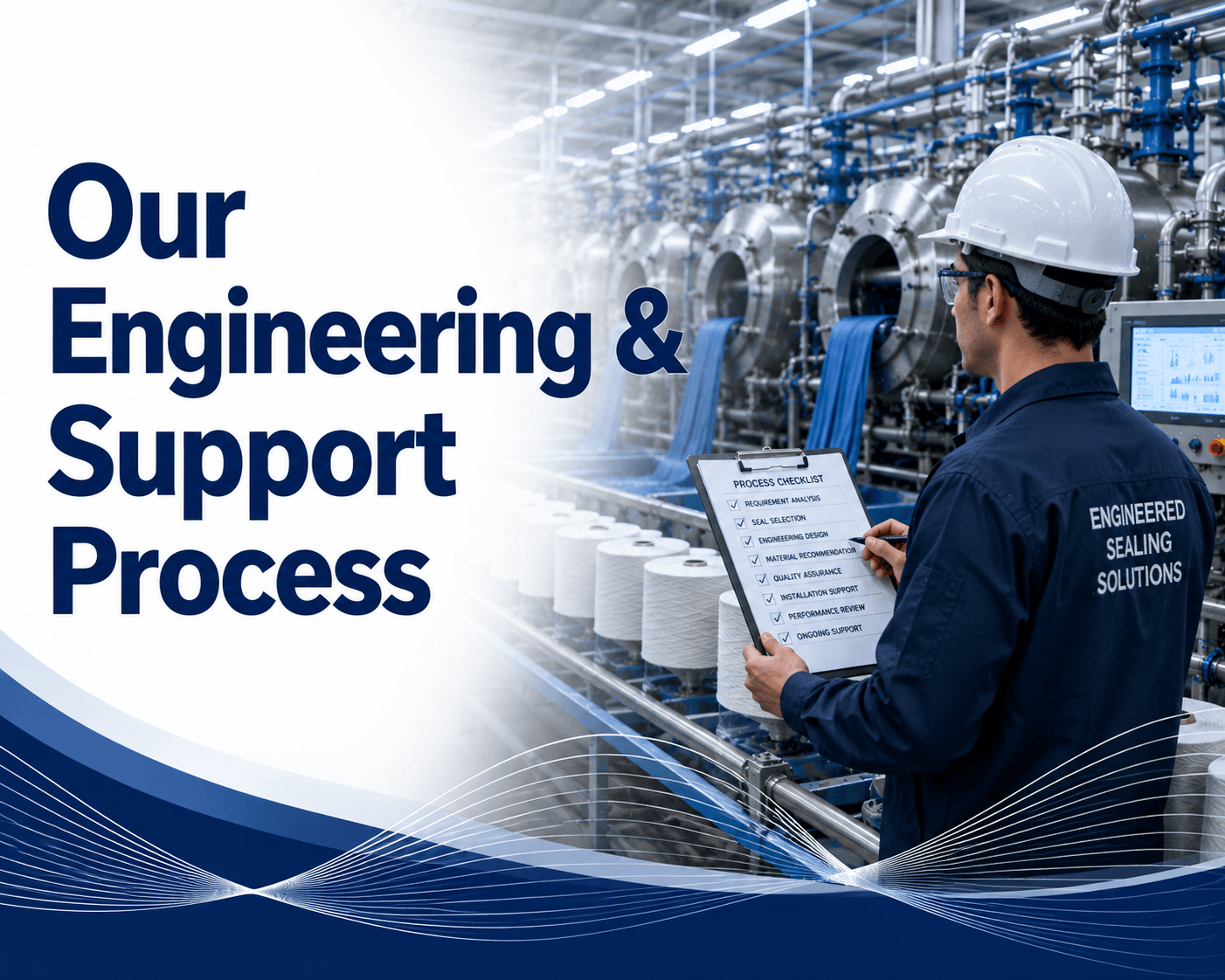
Our Engineering & Support Process

Our Engineering & Support Process

  • Process recipe review — dye or chemical type, temperature profile, and batch cycle frequency
  • Seal arrangement recommendation based on thermal cycling severity and chemical exposure
  • Material selection matched to both the thermal cycle and the specific dye or finishing chemistry
  • Drawing approval before manufacturing begins — including fully custom-engineered designs for non-standard or imported dyeing machines
  • In-house manufacturing and quality testing with material traceability documentation
  • Installation guidance and, where required, on-site commissioning support
Why Textile Mills Choose Leak-Pack

Why Textile Mills Choose Leak-Pack

  • Seal specifications built for both thermal cycling and dye chemistry, not one addressed at the expense of the other
  • Elastomer-free options for high-cycle-frequency dyeing machines and bleaching ranges
  • Multi-spring and support system options for effluent and printing paste handling
  • Material traceability documentation to support buyer chemical management programs
  • Fast turnaround for replacement seals to limit production schedule impact
  • Direct engineering support — not just a catalogue sale

Material Selection Guide

Below is a general guide to the materials we typically recommend by pharmaceutical application. Final material selection is always confirmed against your specific product contact requirements, sterilization method, and any regulatory material restrictions that apply to your facility

ApplicationSeal Face CombinationSecondary Seal / ElastomerWetted Metallurgy
General sterile mixingSilicon Carbide vs. Silicon CarbideEPDM (steam-grade)316L Stainless Steel
Bioreactors & fermentersSilicon Carbide vs. Silicon CarbideFFKM (Kalrez-type)316L Stainless Steel
Solvent & API transferSilicon Carbide vs. Silicon CarbideFFKM (Kalrez-type)316L Stainless Steel
High-temperature SIP serviceSilicon Carbide vs. Silicon CarbidePTFE / Metal bellow (no elastomer)316L Stainless Steel
Powder handling & granulationSilicon Carbide vs. CarbonFKM (Viton)316L Stainless Steel

Frequently Asked Questions

Yes. We design pharmaceutical seals for crevice-free, fully cleanable construction, and specify materials — including steam-grade elastomers or elastomer-free bellow designs — rated for repeated CIP and SIP cycling.

Yes. We can supply material certification and traceability documentation for wetted components where your facility’s regulatory submissions or GMP documentation require it.

We manufacture double seal arrangements specifically for bioreactors and fermenters, engineered to maintain sterility across extended runs and to prevent any product contact with atmosphere, in addition to standard pump and agitator seals.

For applications where any contamination risk is unacceptable, we typically recommend a double seal arrangement with a validated, product-compatible barrier fluid, so the primary seal is fully backed up and the process never contacts atmosphere.

Yes. We specify seal arrangements and support systems rated for the vacuum and pressure cycling common in pharmaceutical mixing and reaction processes within a single batch.

Yes. Our cartridge and agitator seal designs are engineered for retrofit onto most existing pharmaceutical vessels and pumps, including as a direct replacement for underperforming or non-compliant competitor seals.

Yes. We supply seals for centrifuges, filtration equipment, and powder-handling systems such as granulators and tablet coaters, where product containment is as critical as it is in liquid processing.

Lead times depend on seal size, arrangement complexity, and any custom documentation requirements. For standard cartridge seal replacements, we prioritize fast turnaround to minimize batch process downtime — share your seal drawing or vessel details with our team for a firm timeline.

Talk to Our Sealing Engineers

Every pharmaceutical process runs a different combination of product, sterilization method, and validation requirement, which is why we don’t work off a fixed catalogue selection for this industry — every seal we quote starts with your actual process and compliance requirements. We’re happy to work alongside your quality and validation teams where a seal specification needs to be reviewed as part of a broader documentation package.

Send us your reactor, mixer, or pump specifications — product contact requirements, sterilization method, and operating conditions — and our engineering team will recommend the right seal solution for your application. Explore our full range of mechanical seals by industry or send an enquiry directly.