Power generation runs some of the highest-pressure and highest-temperature pumping applications in industry — boiler feed water pumps alone can operate well beyond 100 bar and 150°C, conditions that push mechanical seal design to its structural limits. A seal failure on critical power plant equipment doesn’t just cost the price of the part; on boiler feed, condensate, or circulating water systems, it can force a unit derate or full shutdown, with lost generation revenue that dwarfs the cost of almost any seal replacement.
At Leak-Pack Engineering, we design and manufacture mechanical seals for thermal, hydro, and captive power plant equipment — boiler feed pumps, condensate extraction pumps, ash and slurry handling systems, and cooling water circuits — engineered for the pressure, temperature, and reliability standards this industry demands. Our engineering team works from your unit’s actual operating parameters, consistent with ASME Boiler and Pressure Vessel Code principles for pressure-retaining equipment, to recommend the right seal design and arrangement.

In most industries, seal selection balances several competing factors somewhat evenly. In power generation, pressure and temperature dominate the decision, because boiler feed water service routinely exceeds the practical operating envelope of standard mechanical seal designs. A seal specified without full regard for a unit’s actual pressure and temperature profile — including startup, shutdown, and load-swing transients, not just steady-state operating point — is a leading cause of premature failure on this equipment.
Uptime consequences compound this. A forced outage on a generating unit carries a cost structure unlike almost any other industry: lost generation revenue, potential grid stability implications, and in regulated markets, contractual availability penalties. Research bodies such as EPRI have extensively documented pump and seal reliability as a material driver of plant availability, which is why power plant operators typically size seal specifications toward maximum reliability and predictable service intervals rather than lowest first cost.
This reliability-first mindset extends to how we approach seal support systems on this equipment — a boiler feed pump seal is rarely specified as a standalone component; the barrier fluid system, cooling arrangement, and instrumentation around it are equally responsible for whether the seal survives a startup transient or an unplanned trip.

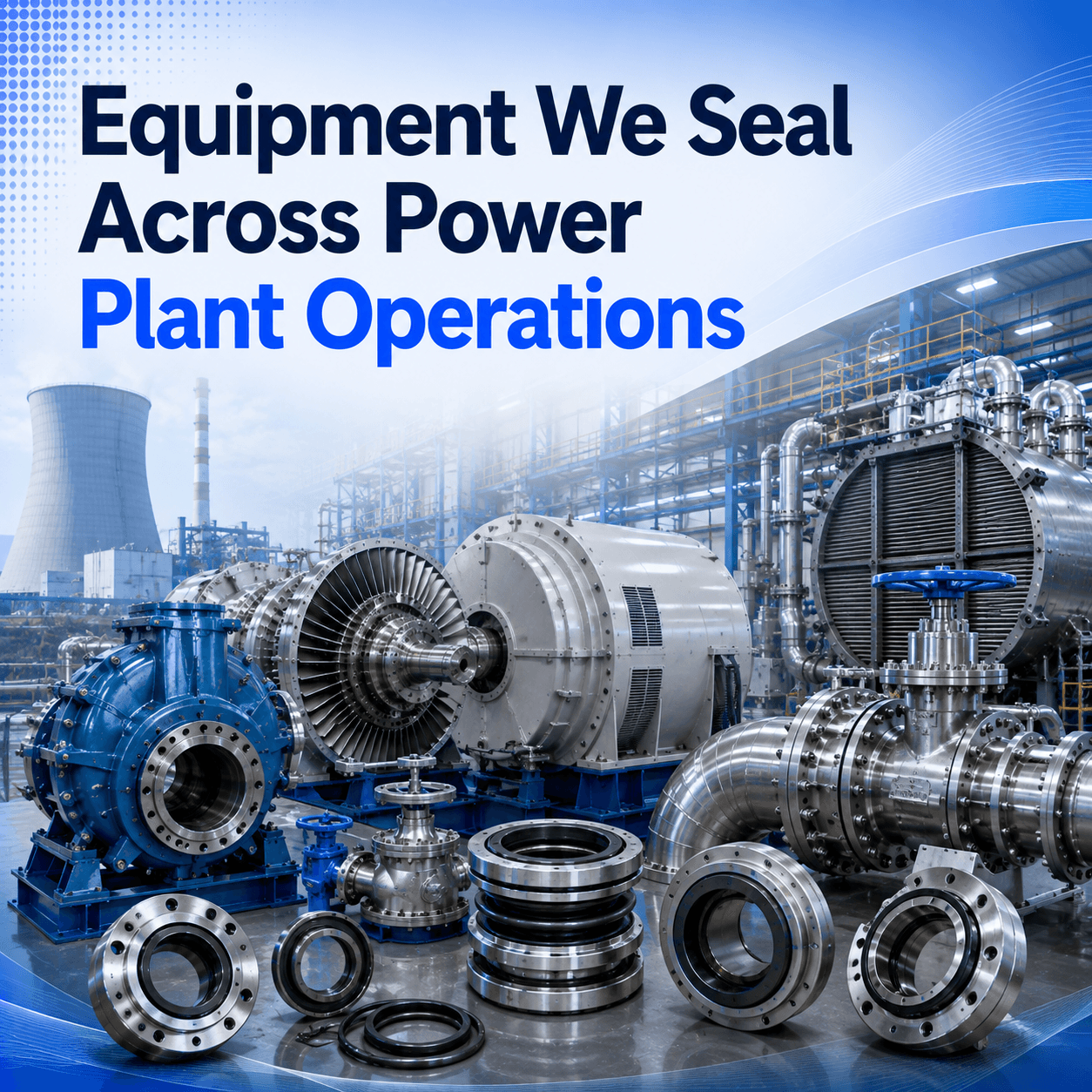
Power plants run equipment across water-steam cycle, ash handling, and cooling water systems, each with a distinct pressure, temperature, and media profile. We supply seals across this full range:

As in other heavy process industries, these requirements rarely stand alone — a boiler feed pump seal typically has to survive extreme pressure and temperature, resist any abrasive carryover, and deliver predictable service life through a full outage cycle, all at once. We size the specification to all three simultaneously.


Below is a general guide to the materials we typically recommend by power plant application. Final material selection is always confirmed against your specific unit’s pressure, temperature, and startup/shutdown operating profile.
| Application | Seal Face Combination | Secondary Seal / Elastomer | Wetted Metallurgy |
|---|---|---|---|
| Boiler feed water (high pressure) | Silicon Carbide vs. Silicon Carbide | FFKM (Kalrez-type) | 316 SS / Duplex |
| Condensate & low-pressure service | Silicon Carbide vs. Carbon | EPDM | 316 Stainless Steel |
| Ash & slurry handling (coal/thermal) | Tungsten Carbide vs. Silicon Carbide | EPDM / FKM | 316 SS / Duplex |
| Cooling water & circulating systems | Silicon Carbide vs. Carbon | EPDM | 316 Stainless Steel |
| High-temp steam / hot process lines | Silicon Carbide vs. Silicon Carbide | PTFE / Metal bellow (no elastomer) | 316 SS / Hastelloy |
Yes. We specify elastomer-free metal bellow designs for boiler feed water and other high-pressure, high-temperature service, engineered to survive both steady-state operation and startup/shutdown thermal transients.
Yes. Our multi-spring seal designs and hard-face combinations are specified to resist erosive wear from ash, bottom slurry, and FGD system media.
Yes. Our split and cartridge seal designs are engineered for installation without full pump disassembly, helping seal replacement fit within tight planned outage schedules on large circulating water and feedwater pumps.
Yes. We engineer barrier and buffer fluid support systems sized to your unit’s full operating profile — startup, steady-state, and shutdown — rather than a generic support package.
Yes. We offer fully custom-engineered seal designs for legacy or non-standard pump configurations common in older generating units.
Lead times depend on seal size, pressure rating, and material availability. Given how costly a forced outage is relative to the seal itself, we prioritize fast turnaround on power plant replacement seals — share your seal drawing or pump details with our team for a firm timeline.
Yes. We supply seals across thermal, hydro, and captive power plant equipment, engineered to each unit’s specific operating parameters regardless of plant scale.
Yes. Our cartridge and metal bellow seal designs are engineered for retrofit onto most existing power plant pumps, including as upgrades from seals that are underperforming under actual operating transients.
Every generating unit runs a different combination of pressure, temperature, and operating cycle, which is why we don’t work off a fixed catalogue selection for this industry — every seal we quote starts with your unit’s actual operating profile and outage risk tolerance. We’re happy to work alongside your plant reliability and maintenance planning teams to time seal specification and delivery around your outage schedule.
Send us your pump specifications — pressure, temperature, startup/shutdown profile, and media composition — and our engineering team will recommend the right seal solution for your application. Explore our full range of mechanical seals by industry or send an enquiry directly.